Biopsies
Fifteen years ago today, I met my breast surgeon. My primary care doctor said she was the best breast surgeon in town, and that was a small comfort to me. I asked my like-a-mom, Barbara, to come with me to the surgeon’s office, and my friend, Liz, also came.
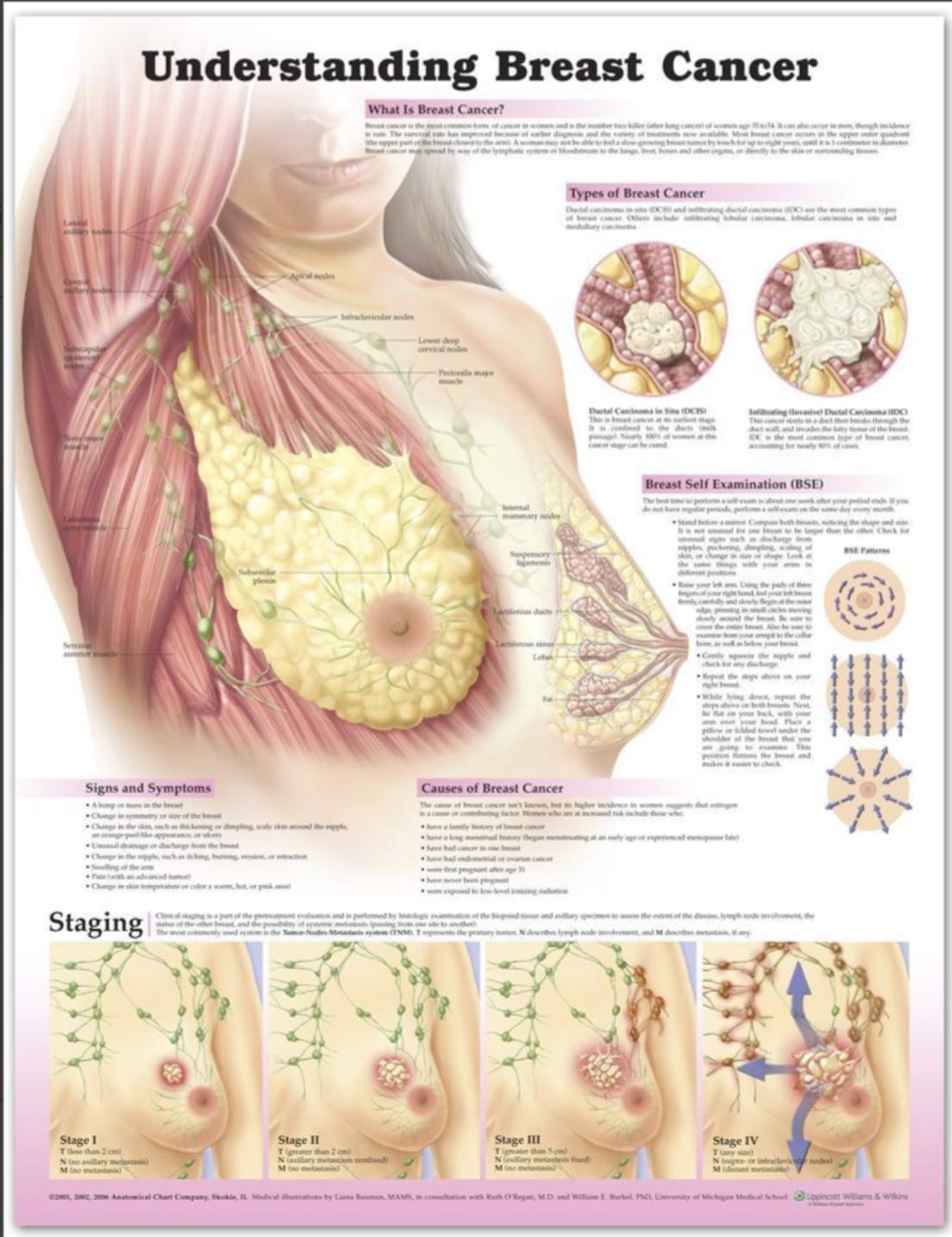
They called my name, and we went into the exam room. This was my first exposure to THE POSTER. In just about every oncology exam room I’ve been in, there’s a medical poster entitled, “Understanding Breast Cancer.” It features a medical drawing of healthy breast tissue and the musculature and lymph system around the breast. It shows the types of breast cancer - it turns out that “breast cancer” is actually an umbrella term for many different types of cancer of the breast - and along the bottom, it shows medical illustrations of the four stages and what is involved with each one. If the goal is to understand in a few minutes the gist of the physical attributes of breast cancer, I guess Understanding Breast Cancer is as good a name as any. Over the years, however, I’ve been irritated at the name of this poster because in no way does it help someone understand what being a breast cancer patient means.
I told the surgeon about the radiologist’s comments - how he was sure it was cancer. She said we won’t know for sure if it’s cancer until we get biopsy results back. She said she was prepared to do the biopsies that day. A nurse escorted me to a very cold, dimly lit, sterile room. I put on a paper top, open to the front.
If you’re squeamish - skip the next three paragraphs.
I wish I could tell you that I had looked up what the procedures were for breast biopsies. Alas, I did not. The doctor said she would inject some lidocaine into my skin, cut a tiny incision, and insert a hollow, pointed metal tube into my breast where she thought the mass was and suck out some tissue through the tube. Since a mass was palpable in the upper left quadrant of my breast, near my armpit, and the bottom right quadrant, near my sternum, she said she would do the procedure twice. These are called stereotactic core-needle biopsies, but we could just refer to them as torture, because that’s a much more apt description.
Since I had an enlarged lymph node in my armpit, she said that she would biopsy that as well, but that only involved injecting a syringe into the node and drawing fluid out. Like a reverse shot. That’s called a fine-needle aspiration.
I held my left arm over my head, and she opened the paper top. It was freezing in the room, so I was cold. I was also terrified, and I get cold when I’m scared. I actually feel cold right now, as I recall and write about this, in my warm house, fifteen years later. The surgeon injected the lidocaine, cut the hole, and put a tube into the tissue of my breast. She turned on a vacuum connected to the needle so she could remove several samples of tissue. She moved the needle around, not unlike one would when vacuuming a rug. Then, she did that same thing all over again in a different area of my breast. While I guess I’m grateful for lidocaine, it numbs the upper layers of skin, not the underlying layers or the fat underneath. So that vacuuming with the hollow pointed needle did not feel good.
She applied pressure to stop the bleeding from the incisions, and then did the armpit biopsy last. By that point, I was about to lose my mind. I wasn’t flailing about, although I wouldn’t blame anyone in that position for doing so. But I was shaking and probably well on my way into shock. She sat at the foot of my bed and said something to the effect of this:
“I know you’re scared. You don’t know what all this means or what will happen. But whatever these results are, I will know exactly what to do.”
That was actually the best thing she could have done in that moment. I walked out of there with tiny ice packs over the incisions and aftercare instructions, which included this helpful information: “Some patients find they can return to work immediately after biopsies.” That was confusing to me, because how could anyone be expected to think clearly after that torture? They need different aftercare for fine-needle aspirations and core-needle aspirations. Also, this procedure should be done under anesthesia. Or under the influence of a lot of Xanax.
I went home and got into bed. My appointment to get the biopsy results was first thing in the morning on February 28th. So I had a six-day wait ahead of me. I was pretty sure by this point that I did have breast cancer.